Jason Salazar
The Legend of William OhJason Salazar is a twelve-year-old orphan whose hunger for escape makes him William Oh’s earliest promoter and prospective companion. Scrawny, verbally agile, and willing to bargain with almost anyone, he converts admiration into labor: first by persuading William Oh to take him seriously, then by circulating extravagant stories that allow William Oh’s reputation to outrun his actual achievements. Jason’s importance lies less in physical power than in his ability to make a story about William Oh travel.
Identity and Introduction
Jason first appears in Saint Gertrude’s Orphanage pleading to leave with William Oh. He kneels with his palms clasped while William Oh unwinds his bandages and reveals fresh scabs, a visual reminder that Climbing is dangerous rather than glamorous. Jason nevertheless identifies it as a possible escape from the orphanage. He offers to dig latrines, establish camp, stand night watch, and taste food for poison. When he says that he will be the only boy left behind, Thomas, an eight-year-old, objects; Jason immediately revises the claim to being the oldest boy instead. The quick correction captures both his youth and his instinct for preserving a persuasive appeal.
Jason’s decisive proposition is that he can serve as a hype man. He explains the role as praising someone when that person is absent, making it easier for the subject to deceive a target or impress potential romantic partners. The definition is comic, but it also establishes Jason’s practical intelligence. He understands reputation as a resource that can be deliberately produced, circulated, and exchanged. His speech is not merely admiration; it is a proposed occupation.
The Bargain with William Oh
William Oh refuses to let Jason enter The Trial immediately. Everyone must complete The Trial alone before beginning Climbing, and the institution excludes twelve-year-olds because of the danger. William Oh also judges Jason too frail even for the following year, describing him as a scrawny thirteen-year-old in prospect and poking his ribs to emphasize the point. Jason’s trembling lip appears calculated to evoke pity, suggesting that his emotional displays are as instrumental as his promises.
The compromise turns Jason’s weakness into a project. William Oh gives him silver under the condition that Jason gain five inches of height by the next Hunt and promote him to anyone willing to listen. Jason’s assignment is to last until he can join William Oh’s Party the following year; in return, William Oh promises to help him obtain the Sacrifices needed for his own Class. The arrangement combines mentorship, employment, and deferred partnership. It also exposes the unequal power between them: Jason receives a genuine opportunity, but William Oh threatens to punish him if the money goes toward toys, expensive clothing, or candy rather than physical development.
William Oh estimates only a twenty-percent chance that Jason will actually use the money to become bigger and stronger. Yet that same twenty percent represents a meaningful chance of gaining a reliable team member. Jason has already demonstrated that he can obtain five silver from another orphan, so his verbal skill is treated as evidence of usefulness even when his discipline remains uncertain. William Oh’s calculation is therefore characteristically pragmatic: Jason does not need to be dependable in every respect if he can become dependable enough in one strategically valuable role.
Manufacturing William Oh’s Reputation
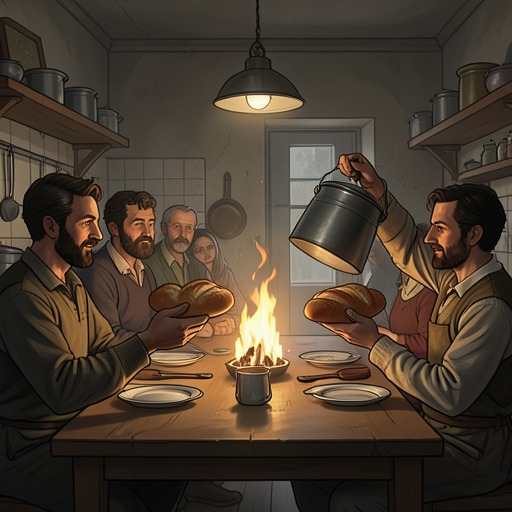
Jason fulfills the promotional side of the agreement with theatrical commitment. In Brenda’s Inn, he presents William Oh as the smartest, most talented, most formidable, and most stoic person the town has produced. He performs this praise while eating stew, a meal that is plainly superior to the orphanage’s bread and gruel despite its burnt taste and scarcity of meat or vegetables. The scene places Jason’s rhetoric beside his material circumstances: his grand claims are delivered by a hungry child whose immediate reward is a better bowl of food.
His performance repeatedly turns William Oh into a subject of conversation. Jason asks others whether they have heard of William Oh, including a priestess and later William Oh himself when he slides into the seat across from him at the inn. William Oh responds that he has not heard of William Oh, recognizing the absurdity of a reputation being announced back to its supposed owner. Jason’s promotional voice also appears in written form when he claims that William Oh is so popular that he had to reject dozens of young women seeking to join his first quest, supposedly to spare them from spending the rest of their lives unable to find another man who could compare with him. The extravagant account is attributed to Jason Salazar and turns ordinary recruitment into romantic legend.
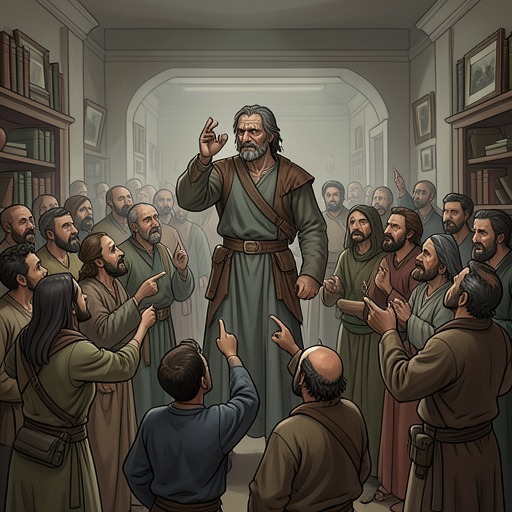
The stories grow more elaborate as William Oh’s adventures continue. Jason tells listeners that William Oh was born on the Hundredth Floor and bathed in lethal Miasma, a claim that another Climber immediately questions because nobody has reached that floor and no pregnant woman could plausibly have approached it. The tale is knowingly implausible, but its function is not factual accuracy. It supplies a mythic explanation for abilities that ordinary observers cannot easily understand.
By the time William Oh returns from later exploits, rumors attribute to him the power to turn into lightning, a thundercloud-generating Ability, and even the capacity to eat a lightning bolt fired into his face. Other versions recast his missing hand as a witch’s curse and a roaming talisman that brings ill fortune to enemies. These stories exceed Jason’s documented speeches, yet they reveal the social system his work has helped activate: William Oh’s identity becomes detachable from William Oh’s body, reproduced by strangers who add new feats, causes, and supernatural explanations. The legend grows through repetition, embellishment, and public appetite rather than through direct verification.
Role in the Larger Climb
Jason’s publicity intersects with the formal machinery of The System. William Oh receives an Establishing Quest to break the supply lines supporting the Kaith on the First Floor, and later receives a new quest to ascend to the 2nd Floor after reaching level five. Jason’s promotion gives these achievements a human audience before official recognition can stabilize them. Even the quest-reward bureaucracy reflects the instability of his name: when William Oh arrives to claim a reward, the clerk says that five other people have attempted to steal it, while six claimants have appeared under the name William Oh and only one seems to match the proper record.
Jason’s hype therefore has consequences beyond humor. It creates a name valuable enough to counterfeit and famous enough to attract attention. His words help make William Oh socially legible as an exceptional Climber, while the resulting reputation generates confusion over identity and ownership. The System can rate William Oh’s performance as exceptional, but Jason’s informal publicity determines how ordinary people imagine what that exceptional performance means.
Jason also remains connected to William Oh’s practical plans. After William Oh is injured, Jason follows through beyond the minimum required by their bargain, but William Oh still refuses to trust a twelve-year-old with enough money to obtain a Class, believing Jason would inevitably spend it that way. Once William Oh is Charged, has his stitches removed, and is ready to return to Climbing, Jason’s continuing usefulness is measured against the demands of travel, hunting, and team formation rather than sentiment alone. His future remains conditional: he may become a Party member, but only if his promises and self-improvement hold.
Narrative Function and Significance
Jason functions as an ally, comic exaggerator, and informal herald. He announces William Oh’s importance before the plot’s institutions and strangers fully recognize it, making him an early mechanism through which the protagonist’s fame enters the world. His role also creates a contrast between bodily vulnerability and social power. Jason cannot yet pass The Trial or safely join the Climb, but he can influence how stronger and older people interpret William Oh.
His rhetoric is deliberately unreliable as biography but reliable as evidence of social transformation. The Hundredth-Floor origin story, the claims about lightning, and the romantic fantasy of rejected admirers are not trustworthy accounts of William Oh’s life. They are traces of a reputation being assembled in public. Jason’s talent is to understand that an audience does not require proof before it begins to repeat a compelling version of events.
At the same time, Jason is not reduced to a purely comic mouthpiece. His persistence begins in deprivation: he wants out of the orphanage, fears being left behind, and sees partnership with William Oh as a possible future. His bargain offers him food, money, training, and a route toward Sacrifices and a Class, while William Oh’s bargain offers himself a potential teammate and a propagandist. Their relationship is thus mutually useful without being equal. Jason’s voice gives William Oh a legend; William Oh gives Jason a direction beyond the orphanage. The lasting irony is that the child who invents impossible stories may be one of the most important forces making William Oh’s real achievements impossible for the world to ignore.